
How to Paint Stainless Steel
Stainless steel is famous for its corrosion resistance and sleek metallic appearance. But in some situations, you may want to paint it for:
- Better aesthetics
- Color matching
- Additional protection
- Branding
- Outdoor durability
The challenge is that stainless steel is designed to resist adhesion—including paint adhesion. If you paint it incorrectly, the coating may peel, bubble, or fail quickly.
In this guide, you’ll learn:
- Whether stainless steel can be painted
- The correct preparation process
- Best primers and paints
- Common mistakes to avoid
- Industrial vs household painting methods

1. Can Stainless Steel Be Painted?
Yes.
Stainless steel can absolutely be painted—but proper surface preparation is critical.
Unlike carbon steel, stainless steel has:
- A smooth passive surface
- Low surface roughness
- Strong corrosion resistance
These characteristics make paint adhesion more difficult.
Without proper preparation:
- Paint may peel
- Flake off
- Bubble over time
2. Why Paint Does Not Easily Stick to Stainless Steel
Stainless steel naturally forms a:
chromium oxide passive layer
This layer:
- Protects against corrosion
- Reduces chemical bonding
- Makes surfaces smooth and non-porous
That is excellent for corrosion resistance—but difficult for coatings.
3. When Should You Paint Stainless Steel?
Painting stainless steel is common in:
Architecture
- Decorative panels
- Building facades
- Railings
Industrial Equipment
- Tanks
- Pipelines
- Machinery
Outdoor Applications
- Coastal installations
- Handrails
- Structural components
Commercial Products
- Appliances
- Furniture
- Signage
4. The Best Way to Paint Stainless Steel
The correct process usually includes:
- Cleaning
- Surface roughening
- Priming
- Painting
- Curing
Skipping any step reduces durability dramatically.
5. Step 1 — Clean the Stainless Steel Surface
This is extremely important.
Remove:
- Oil
- Grease
- Dust
- Fingerprints
- Salt deposits
Recommended Cleaners
- Degreasers
- Acetone
- Isopropyl alcohol
Avoid
- Chlorine-based cleaners
- Oily detergents
A contaminated surface causes coating failure.
6. Step 2 — Roughen the Surface
Paint adheres better to textured surfaces.
Common Methods
Sanding
Use:
- 120–220 grit sandpaper
Abrasive Blasting
Industrial applications may use:
- Aluminum oxide blasting
- Garnet blasting
This creates:
Better mechanical adhesion

7. Step 3 — Apply the Correct Primer
Primer is the key to long-lasting paint adhesion.
Best Primers for Stainless Steel
| Primer Type | Best Use |
|---|---|
| Epoxy primer | Industrial environments |
| Self-etching primer | General adhesion |
| Zinc-rich primer | Heavy-duty protection |
Why Primer Matters
Primer:
- Bonds to stainless steel
- Creates adhesion layer
- Improves corrosion protection
Without primer:
Paint failure becomes likely

8. Step 4 — Choose the Right Paint
Different paints perform differently.
8.1 Acrylic Paint
Good for:
- Indoor decorative use
- Furniture
- Light-duty applications
8.2 Epoxy Paint
Excellent for:
- Industrial equipment
- Chemical environments
- Water exposure
Benefits:
- Strong adhesion
- Chemical resistance
- Durability
8.3 Polyurethane Paint
Common for:
- Outdoor architectural stainless steel
- UV exposure
Benefits:
- Weather resistance
- Color retention
- Long-term durability
8.4 Powder Coating
One of the most popular industrial methods.
Advantages
- Durable finish
- Uniform coating
- Excellent appearance
Common on:
- Stainless steel railings
- Panels
- Appliances
- Architectural products

9. Step 5 — Allow Proper Curing
Many coating failures happen because curing is rushed.
Proper curing improves:
- Adhesion
- Hardness
- Chemical resistance
Always follow:
- Manufacturer curing time
- Temperature requirements
- Humidity recommendations

10. Can You Spray Paint Stainless Steel?
Yes.
Spray painting is common for:
- DIY projects
- Appliances
- Decorative applications
However:
Surface preparation is still required.
Use:
- Self-etching primer
- Stainless-compatible spray paint
Thin, multiple coats work better than one thick coat.
11. Can Stainless Steel Be Powder Coated?
Absolutely.
Powder coating is widely used because it offers:
- Excellent durability
- Attractive appearance
- Strong corrosion protection
It is common in:
- Construction
- Marine products
- Outdoor furniture
- Architectural systems
12. How Long Does Paint Last on Stainless Steel?
Durability depends on:
- Surface preparation
- Primer quality
- Paint system
- Environment
- UV exposure
- Salt exposure
Typical Lifespan
| Environment | Expected Coating Life |
|---|---|
| Indoor | 5–10+ years |
| Outdoor | 3–8 years |
| Marine | Depends heavily on coating system |
13. Common Mistakes When Painting Stainless Steel
Mistakes1: Painting Without Sanding
Smooth stainless surfaces reduce adhesion.
Mistakes2: Skipping Primer
This is one of the biggest mistakes.
Mistakes3: Using Wrong Paint
Not all paints bond properly to metal.
Mistakes4: Poor Cleaning
Oil and contaminants destroy adhesion.
Mistakes5: Painting Wet Surfaces
Moisture traps contamination beneath coatings.
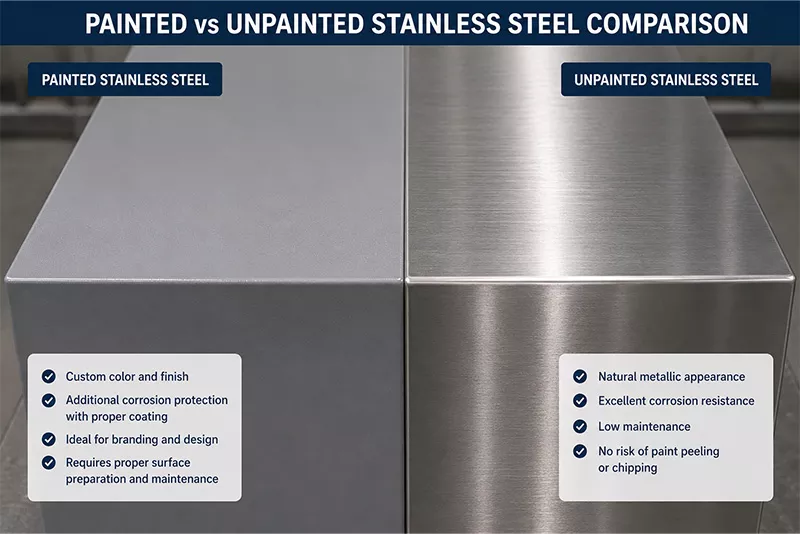
14. Is Painting Stainless Steel Better Than Leaving It Bare?
Not always.
Bare stainless steel already provides:
- Corrosion resistance
- Modern appearance
- Low maintenance
Painting is usually done for:
- Color customization
- Branding
- Additional protection
- Aesthetic design
In many industrial environments, unpainted stainless steel remains the preferred option.
15. Best Stainless Steel Grades for Painted Applications
Different grades behave differently.
| Grade | Typical Use |
|---|---|
| 304 | Indoor painted products |
| 316L | Outdoor / marine |
| 430 | Appliances |
| 2205 Duplex | Harsh industrial environments |
For aggressive environments, corrosion-resistant grades combined with high-performance coatings offer the best long-term durability.
Companies like Kongfang Metal supply stainless steel materials suitable for fabrication, coating, powder coating, and industrial surface treatment applications worldwide.
Conclusion
So, how do you paint stainless steel properly?
The key steps are:
- Thorough cleaning
- Surface roughening
- Proper primer
- Correct paint selection
- Full curing
If done correctly, painted stainless steel can achieve excellent durability and appearance in both decorative and industrial applications.
FAQs
Yes, but only with proper surface preparation and primer.
Absolutely. Primer is essential for adhesion.
Yes. Use self-etching primer and thin paint coats.
Epoxy and polyurethane coatings are among the best options.
Yes. Powder coating provides excellent durability and appearance.


 EN
 ES
 RU
 FR
 PT
 DE
 JA
 KO
 ID
 TR
 AR
