
Best Stainless Steel Grades for Heat Exchangers
Choosing the right stainless steel grade for a heat exchanger depends on more than heat transfer performance. You need to consider corrosion resistance, operating temperature, pressure, fluid composition, chloride exposure and expected service life.
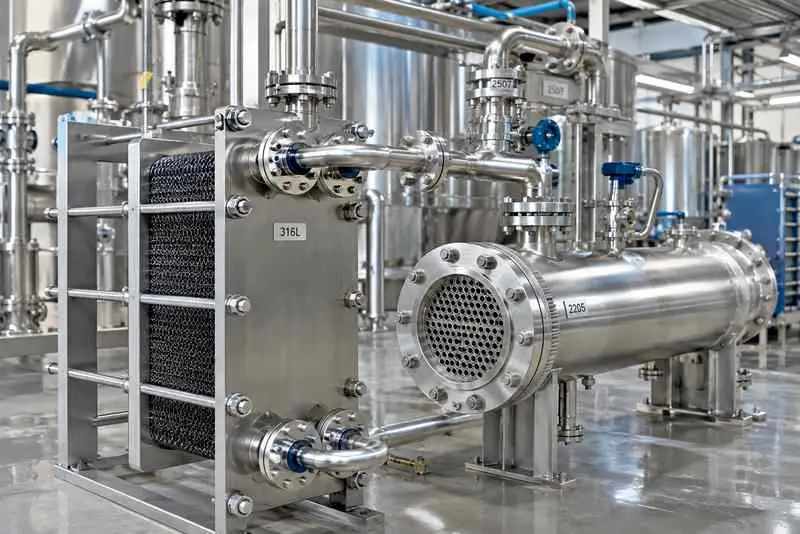
1. What Is the Best Stainless Steel for Heat Exchangers?
There is no single stainless steel grade suitable for every heat exchanger application.
Your material selection should depend on the actual operating environment, including:
- Heat transfer medium
- Fluid chemical composition
- Operating temperature
- Operating pressure
- Chloride concentration
- Flow velocity
- Cleaning method
- Maintenance requirements
- Expected service life
For general applications, 304L and 316L stainless steel are commonly selected because they provide good corrosion resistance, weldability and cost performance.
For more demanding environments such as seawater cooling, desalination, offshore systems and chemical processing, 2205 duplex stainless steel, 2507 super duplex stainless steel and 254 SMO may provide better long-term reliability.
Common heat exchanger applications include:
- Chemical processing
- Oil and gas systems
- Food and beverage production
- Pharmaceutical equipment
- Power generation
- Marine cooling systems
- Desalination plants
- Water treatment facilities
- HVAC systems
The correct stainless steel grade can help you reduce corrosion risk, maintenance costs and unexpected downtime.
2. Quick Comparison of Stainless Steel Grades for Heat Exchangers
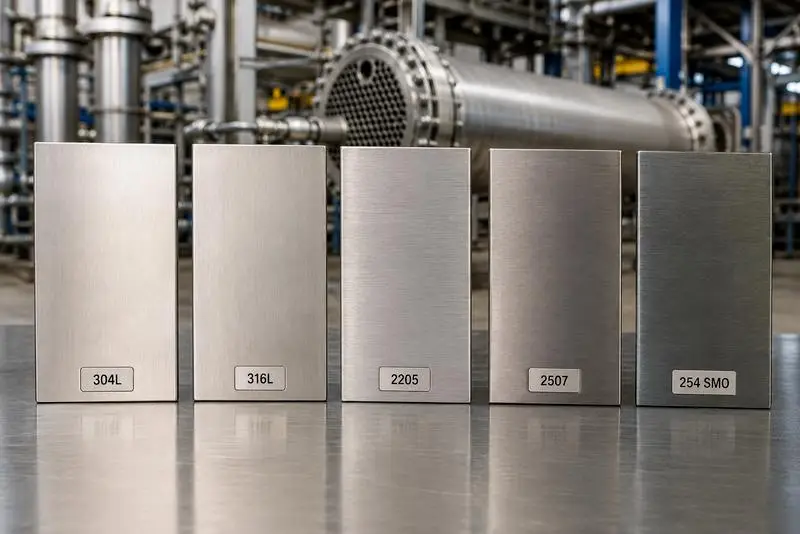
| Comparison Item | 304L | 316L | 2205 Duplex | 2507 Super Duplex | 254 SMO |
|---|---|---|---|---|---|
| Product Positioning | General applications | Corrosive service | Chloride and high-strength systems | Severe marine and chemical service | Extreme corrosion environments |
| Corrosion Resistance | Good | Very good | Excellent | Excellent | Excellent |
| Chloride Resistance | Limited | Better | High | Very high | Very high |
| Strength Level | Standard | Standard | High | Very high | Standard |
| Weldability | Very good | Very good | Controlled welding | Strict welding control | Controlled welding |
| Temperature Performance | Good | Good | Very good | Very good | Excellent |
| Cost Level | Low | Moderate | Higher | High | High |
| Typical Applications | Water, air, mild fluids | Chemical, food, water systems | Seawater, desalination | Offshore, high chloride systems | Extreme chemical and marine systems |
This comparison helps you identify a suitable starting point.
However, you should always evaluate the real operating conditions before making the final decision.
3. 304L Stainless Steel Heat Exchangers for General Applications
Why 304L is commonly used
304L stainless steel is one of the most widely used materials for general heat exchanger applications.
It provides:
- Good corrosion resistance
- Excellent fabrication performance
- Easy welding
- Good availability
- Competitive cost
You may consider 304L heat exchangers for:
- Fresh water systems
- Air heating and cooling systems
- General industrial fluids
- Food processing equipment
- HVAC applications
- Mild process systems
When the heat transfer medium is not highly corrosive, 304L can provide reliable performance.
Advantages of 304L heat exchangers
Good fabrication performance
304L can be easily:
- Formed
- Welded
- Machined
- Manufactured into tubes and plates
This makes it suitable for large-scale production.
Lower material cost
Compared with higher-alloy stainless steels, 304L provides a more economical solution.
For projects with mild operating conditions, it can offer a good balance between performance and cost.
Wide supply availability
304L products are commonly available in:
- Sheets
- Plates
- Tubes
- Pipes
- Bars
- Fittings
This simplifies procurement and maintenance.
Limitations of 304L
304L should not be considered suitable for all heat exchanger applications.
You should be careful when using 304L with:
- Seawater
- High chloride fluids
- Salt solutions
- Chemical solutions
- Warm corrosive media
Potential failure risks include:
- Pitting corrosion
- Crevice corrosion
- Stress corrosion cracking
For chloride-containing applications, 316L or duplex stainless steel is usually a better choice.
4. 316L Stainless Steel Heat Exchangers for Corrosive Media
Why 316L is widely selected
316L is one of the most commonly used stainless steel grades for industrial heat exchangers.
The addition of molybdenum improves resistance to:
- Chloride corrosion
- Pitting corrosion
- Crevice corrosion
Compared with 304L, 316L provides a stronger corrosion resistance margin.
You may choose 316L for:
- Chemical processing equipment
- Food processing systems
- Pharmaceutical applications
- Water treatment systems
- Marine cooling systems
- Industrial heat exchangers
Typical applications of 316L heat exchangers
Chemical industry
316L is often used for:
- Mild acids
- Organic chemicals
- Process fluids
- Cleaning systems
Food industry
Applications include:
- Beverage systems
- Dairy equipment
- Sanitary heat exchangers
- CIP cleaning systems
Water treatment
Used in:
- Process water systems
- Purified water equipment
- Cooling systems
Why 316L may still fail
316L provides excellent corrosion resistance, but it is not resistant to every environment.
You should carefully evaluate:
- Chloride concentration
- Temperature
- Fluid velocity
- Cleaning chemicals
- Exposure time
316L may not be suitable for:
- Warm seawater
- Concentrated brine
- Severe chloride systems
- Strong acids
- High-temperature chemical environments
When corrosion risk increases, duplex stainless steel or high-alloy stainless steel may provide better performance.
5. Duplex 2205 Stainless Steel Heat Exchangers for Chloride Environments
Why 2205 is increasingly used
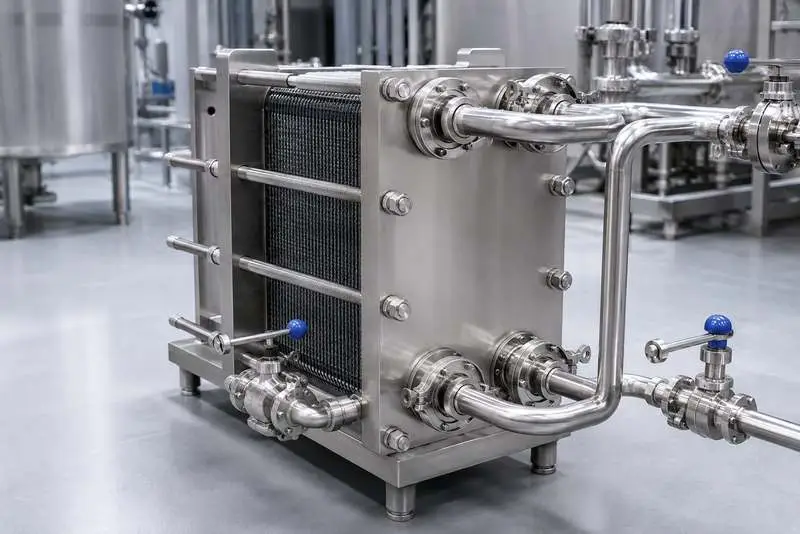
2205 duplex stainless steel combines austenitic and ferritic structures.
It provides:
- Higher strength than 316L
- Better chloride resistance
- Better resistance to stress corrosion cracking
- Excellent overall corrosion performance
You may consider 2205 for:
- Seawater heat exchangers
- Desalination systems
- Chemical cooling systems
- Offshore equipment
- High-chloride process systems
Advantages of 2205 heat exchangers
Higher mechanical strength
2205 has much higher strength than conventional austenitic stainless steel grades.
This can help you:
- Reduce material thickness
- Reduce equipment weight
- Improve structural performance
Better chloride resistance
2205 performs better in:
- Salt water
- Brine
- Chloride-containing chemicals
It is often selected when 316L reaches its corrosion resistance limit.
Fabrication requirements
2205 requires more controlled manufacturing.
You should ensure:
- Qualified welding procedures
- Suitable filler metals
- Heat input control
- Ferrite balance control
- Pickling and passivation
- Final inspection
Poor fabrication can reduce duplex stainless steel performance.
6. 2507 Super Duplex Stainless Steel Heat Exchangers for Severe Service
Why choose 2507
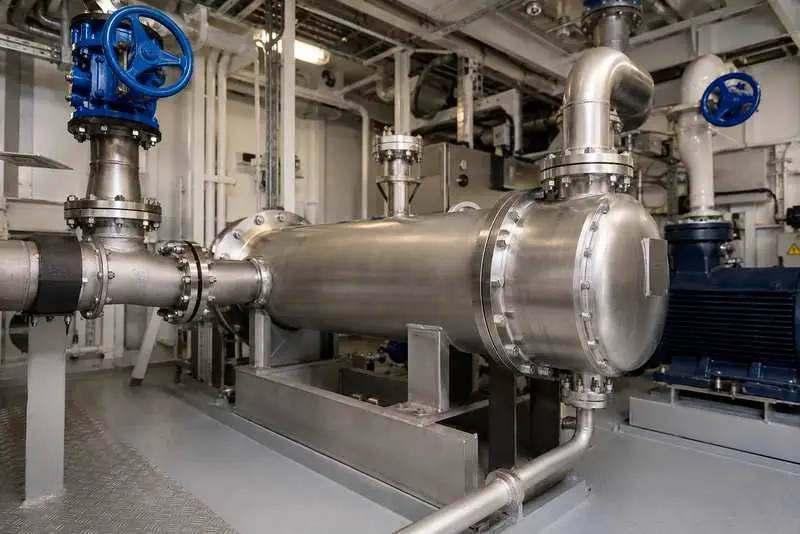
2507 super duplex stainless steel provides higher alloy content than 2205.
It contains increased:
These elements improve resistance to:
You may consider 2507 for:
- Offshore heat exchangers
- Seawater cooling systems
- High-pressure equipment
- Severe chloride environments
- Desalination plantsTypical applications
2507 is commonly used in:
- Seawater heat exchangers
- Offshore platforms
- Chemical cooling systems
- High-pressure fluid systems
- Brine circulation equipment
It is selected when failure would create significant maintenance costs or production losses.
When 2507 is unnecessary
2507 provides excellent corrosion resistance, but it is not always the most economical option.
You may not need 2507 when:
- The fluid is mild
- Chloride levels are low
- Temperature is moderate
- 316L already provides sufficient performance
The correct grade should solve a real engineering challenge.
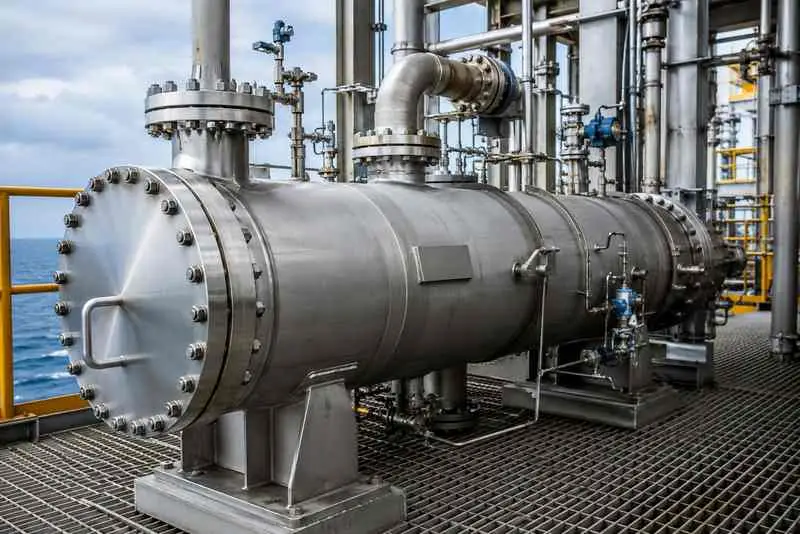
7. 254 SMO Stainless Steel Heat Exchangers for Extreme Corrosion
Why choose 254 SMO
254 SMO is a high-alloy austenitic stainless steel designed for severe corrosion environments.
It provides excellent resistance to:
- Chloride pitting
- Crevice corrosion
- Seawater corrosion
You may consider 254 SMO for:
- Warm seawater heat exchangers
- Chemical processing equipment
- Desalination systems
- Pharmaceutical applications
- High-purity systems
254 SMO vs 316L
Compared with 316L, 254 SMO provides:
- Higher molybdenum content
- Better chloride resistance
- Higher corrosion resistance margin
However, the cost is significantly higher.
You should select 254 SMO when the operating environment requires this level of performance.
8. Titanium vs Stainless Steel Heat Exchangers
When selecting heat exchanger materials, stainless steel is not always the only option.
Titanium is also widely used in highly corrosive environments, especially seawater applications.
You should compare the actual operating conditions before deciding between titanium and stainless steel.
| Comparison Item | Stainless Steel | Titanium |
|---|---|---|
| Corrosion Resistance | Excellent for selected grades | Excellent in seawater |
| Chloride Resistance | Depends on grade | Very high |
| Strength | High for duplex grades | Moderate |
| Weight | Higher | Lower |
| Fabrication | Easier for common grades | Requires special processes |
| Cost | Usually lower | Higher |
| Typical Applications | Chemical, food, water treatment | Seawater, marine, extreme corrosion |
When stainless steel is preferred
Stainless steel heat exchangers are often preferred because they provide:
- Lower material cost
- Better availability
- Easier fabrication
- More product forms
- Better mechanical strength
For many industrial applications, 316L, 2205 or 2507 can provide reliable service without using titanium.
When titanium may be a better choice
Titanium may be preferred for:
- Warm seawater systems
- Highly aggressive seawater
- Chlorine-containing cooling systems
- Long-term marine applications
However, titanium is usually more expensive and requires specialized fabrication.
You should evaluate lifecycle cost rather than only material price.
9. How Heat Exchanger Medium Affects Stainless Steel Selection
The heat transfer medium is one of the most important factors in material selection.
Different fluids create different corrosion risks.
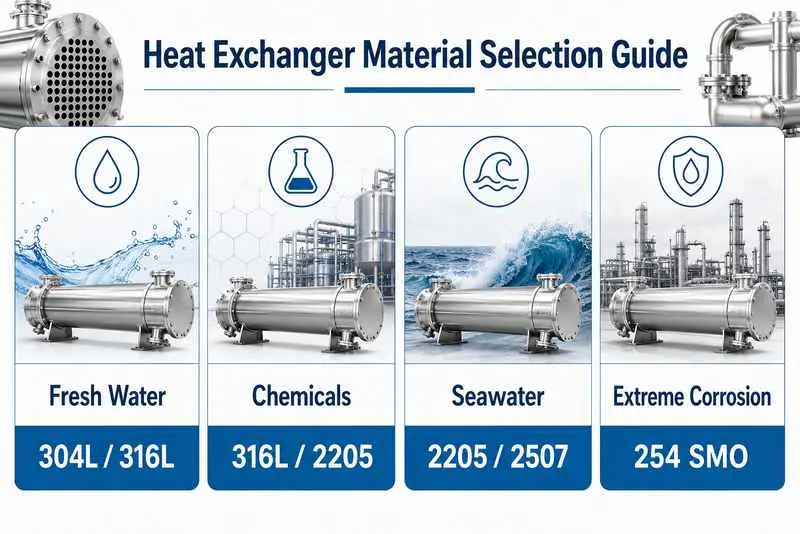
Fresh Water Systems
Fresh water is generally less aggressive than seawater.
You may consider:
The final choice depends on:
- Water quality
- Temperature
- Chloride content
- Treatment chemicals
For industrial water systems, 316L is often selected because it provides additional corrosion protection.
Seawater Heat Exchangers
Seawater contains chlorides that can cause:
For seawater applications:
- 316L may be suitable for mild conditions
- 2205 is often preferred for more demanding systems
- 2507 or 254 SMO may be required for severe environments
You should consider:
- Water temperature
- Flow velocity
- Marine deposits
- Cleaning method
- Service life requirements
Chemical Heat Exchangers
Chemical processing requires careful material evaluation.
You should provide:
- Chemical composition
- Concentration
- Temperature
- Pressure
Possible choices include:
- 316L for general chemical service
- 2205 for chloride environments
- 2507 for severe chloride systems
- 904L or 254 SMO for aggressive chemicals
Steam and High-Temperature Fluids
High-temperature applications require additional consideration.
You should evaluate:
- Thermal cycling
- Oxidation resistance
- Material expansion
- Weld stability
For high-temperature heat exchangers, standard corrosion resistance may not be enough.
10. Temperature Effects on Stainless Steel Heat Exchanger Performance
Temperature has a major influence on corrosion behavior.
A stainless steel grade that performs well at room temperature may fail at higher temperatures.
Increasing temperature can accelerate:
- Chemical reactions
- Chloride attack
- Pitting corrosion
- Stress corrosion cracking
You should provide:
- Normal operating temperature
- Maximum operating temperature
- Start-up temperature
- Shutdown conditions
- Thermal cycling frequency
High-temperature considerations
When temperature increases, you should pay attention to:
- Oxidation resistance
- Mechanical strength
- Weld performance
- Thermal expansion
The selected material should maintain stable performance throughout the operating range.
11. Heat Exchanger Design Factors Beyond Material Selection
Material selection is important, but it is not the only factor affecting service life.
A well-designed heat exchanger reduces corrosion risk and improves efficiency.
You should consider:
Tube and plate thickness
The correct thickness depends on:
- Pressure
- Temperature
- Fluid properties
- Corrosion allowance
- Mechanical loads
A thinner material may reduce cost but increase failure risk.
Flow conditions
Flow velocity affects corrosion behavior.
Very low flow may create:
- Deposits
- Stagnant zones
- Local corrosion
Excessive flow may cause:
- Erosion corrosion
- Surface damage
You should select suitable flow conditions during design.
Fouling control
Deposits can reduce heat transfer efficiency and increase corrosion risk.
Common deposits include:
- Minerals
- Biological materials
- Chemical residues
Proper cleaning design helps maintain performance.
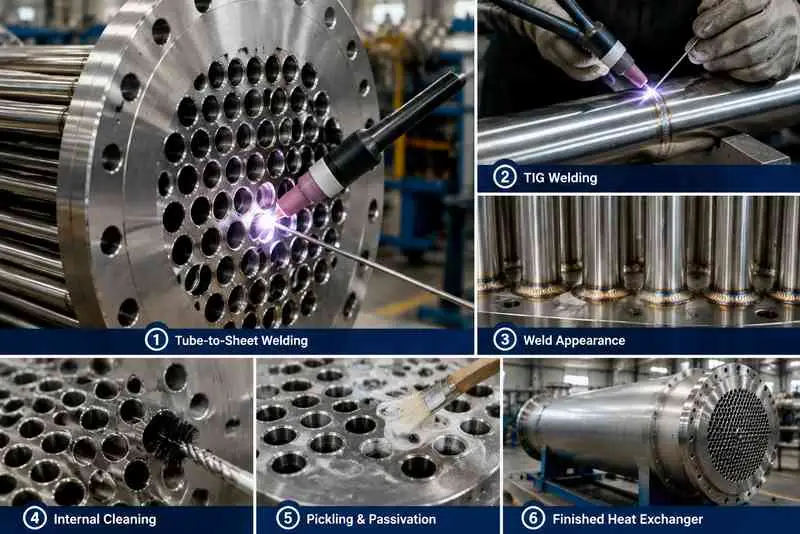
12. Welding and Fabrication Requirements
Heat exchanger performance depends heavily on fabrication quality.
Even a corrosion-resistant stainless steel grade can fail if welding quality is poor.
You should require:
- Qualified welding procedures
- Suitable filler metals
- Controlled heat input
- Proper shielding gas
- Weld inspection
- Pickling and passivation
Weld areas require special attention
Critical areas include:
- Tube-to-sheet joints
- Pipe connections
- Nozzle welds
- Internal weld surfaces
- Flange areas
Poor weld quality can create:
- Crevice corrosion
- Reduced corrosion resistance
- Leakage problems
Duplex stainless steel welding
For 2205 and 2507, welding control is especially important.
You should monitor:
- Heat input
- Cooling rate
- Ferrite balance
- Interpass temperature
Correct welding procedures help maintain duplex performance.
13. Surface Finish and Cleaning Requirements
Surface condition directly affects heat exchanger performance.
A smoother surface helps reduce:
- Deposits
- Fouling
- Cleaning difficulty
- Local corrosion risks
You should define:
- Surface finish
- Internal roughness requirements
- Cleaning procedure
- Passivation requirements
Why surface finish matters
Rough surfaces can trap:
- Chemicals
- Salt deposits
- Biological materials
These areas may become corrosion initiation points.
For sanitary or high-purity applications, surface finish requirements are especially important.
14. Material Certification and Inspection
For heat exchanger projects, you should request complete material documentation.
Important documents include:
- EN 10204 3.1 certificate
- Chemical composition report
- Mechanical properties
- Heat number traceability
- Dimensional inspection records
- Surface inspection reports
For critical applications, additional inspection may include:
- PMI testing
- Hydrostatic testing
- Eddy current testing
- Ultrasonic testing
- Welding inspection
- Pressure testing
Complete documentation helps ensure that the supplied material matches your approved specification.

15. Common Mistakes When Selecting Stainless Steel Heat Exchangers
Choosing 316L for every application
316L is widely used, but it is not suitable for every environment.
Seawater, high chlorides and severe chemicals may require duplex or high-alloy grades.
Selecting only by purchase price
A cheaper material may result in:
- Corrosion failure
- Production downtime
- Higher maintenance costs
- Early replacement
You should compare total operating cost.
Ignoring tube sheet material
Heat exchangers contain multiple components.
You should consider:
All wetted parts should match the service environment.
Ignoring cleaning conditions
Cleaning chemicals may be more aggressive than the process fluid.
Always include cleaning conditions during material selection.
Neglecting fabrication quality
The correct stainless steel grade cannot compensate for:
- Poor welding
- Contamination
- Improper finishing
- Incorrect installation
16. Practical Stainless Steel Grade Selection Guide
Choose 304L when:
- The medium is mild
- Chloride levels are low
- Temperature is moderate
- Cost control is important
Choose 316L when:
- General corrosion resistance is required
- Chemical exposure is moderate
- Food, pharmaceutical or water applications are involved
- Chloride levels are controlled
Choose 2205 Duplex when:
- Chloride exposure is high
- Seawater is involved
- Higher strength is required
- Stress corrosion cracking is a concern
Choose 2507 Super Duplex when:
- Conditions are severe
- Pressure is high
- Seawater or brine service is involved
- Long service life is required
Choose 254 SMO when:
- Extreme chloride resistance is needed
- Warm seawater is present
- High-alloy corrosion resistance is required
17.Final Recommendation
For general heat exchanger applications, 304L and 316L stainless steel are usually the most practical choices.
For seawater cooling, chloride-containing fluids and demanding industrial systems, 2205 duplex stainless steel provides higher strength and better corrosion resistance.
For severe marine, offshore and chemical environments, 2507 super duplex and 254 SMO can provide longer service life and improved reliability.
Kongfang Metal supplies stainless steel materials for heat exchangers, pressure equipment, chemical systems and industrial processing applications.
Available products include:
- Plates and sheets
- Coils and strips
- Seamless and welded pipes
- Round bars
- Flanges and fittings
- Forgings
- Cut-to-size parts
- Custom processed components
Available grades include:
FAQs
Yes. 316L is one of the most commonly used stainless steel grades for heat exchangers. It provides good corrosion resistance for chemical, food, pharmaceutical and water applications.
For seawater, high chloride or severe chemical environments, you may need 2205, 2507 or higher-alloy stainless steel.
In many seawater applications, yes.
2205 provides higher strength and better resistance to chloride stress corrosion cracking than 316L. It is often selected for seawater cooling systems, desalination equipment and offshore applications.
The best grade depends on the chemical conditions.
316L is suitable for many general chemical applications. For high chloride environments, 2205 or 2507 may be better. Strong acids or extreme corrosion conditions may require 904L or 254 SMO.
Sometimes.
316L, 2205 and 2507 can replace titanium in many industrial applications with lower cost and easier fabrication.
However, titanium may still be preferred for extremely corrosive seawater or aggressive chloride environments.
Common causes include:
- Incorrect material selection
- High chloride concentration
- Excessive temperature
- Poor weld quality
- Surface contamination
- Deposits and fouling
- Improper cleaning chemicals
The stainless steel grade should match the actual operating conditions.
You should request:
- EN 10204 3.1 certificate
- Heat number traceability
- Chemical composition
- Mechanical properties
- Material standard
- Inspection records
For critical applications, PMI, pressure testing and additional inspection may also be required.


 EN
 ES
 RU
 FR
 PT
 DE
 JA
 KO
 ID
 TR
 AR
