
How to Tell Aluminum From Stainless Steel: 10 Easy Ways to Identify Them
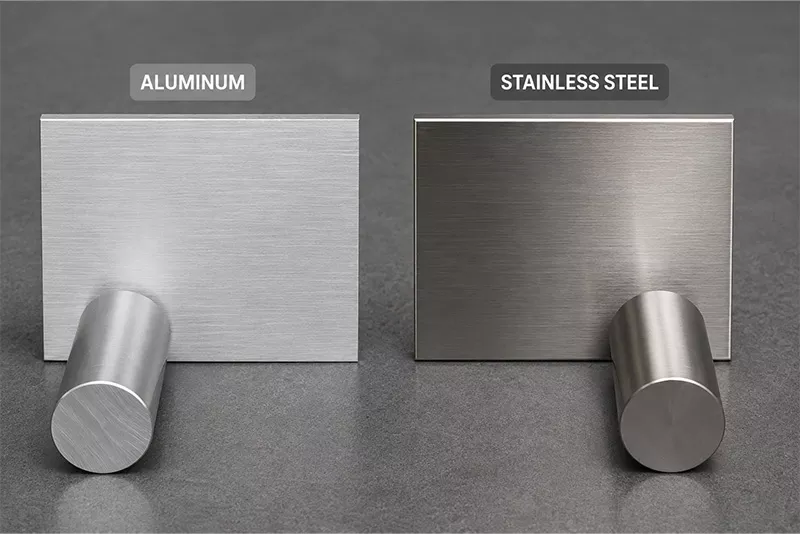
Aluminum and stainless steel are easy to confuse.
Both have a silver appearance, and many sheets, pipes, bars, and fabricated parts look almost identical. If you receive unlabeled material, inspect components, or want to verify what a supplier delivered, identifying the difference can prevent welding problems, corrosion issues, and costly material mistakes.
This guide explains practical identification methods used by fabricators, engineers, inspectors, and industrial buyers.
Why Is It Important to Tell Them Apart?
Although they may look similar, aluminum and stainless steel have very different properties.
| Property | Aluminum | Stainless Steel |
|---|---|---|
| Density | Low | High |
| Weight | Lightweight | Heavy |
| Strength | Moderate | Higher |
| Corrosion Resistance | Good | Excellent |
| Thermal Conductivity | High | Lower |
| Temperature Resistance | Lower | Better |
| Cost | Usually Lower | Usually Higher |
| Wear Resistance | Lower | Better |
Using the wrong material may result in:
- Structural failures
- Welding problems
- Premature corrosion
- Higher maintenance costs
- Product rejection
- Material disputes
For many projects, proper material identification is just as important as selecting the right grade.
Why Do People Mistake Aluminum for Stainless Steel?
This confusion is very common because:
- Both are silver-colored metals.
- Surface finishes can look similar.
- Neither material rusts like carbon steel.
- Brushed aluminum resembles 304 stainless steel.
- Decorative products often hide material markings.
Many buyers rely only on appearance and end up making costly mistakes.
Appearance alone should never be your only method of identification.
Method 1: Check the Weight
Weight comparison is often the fastest field inspection method.
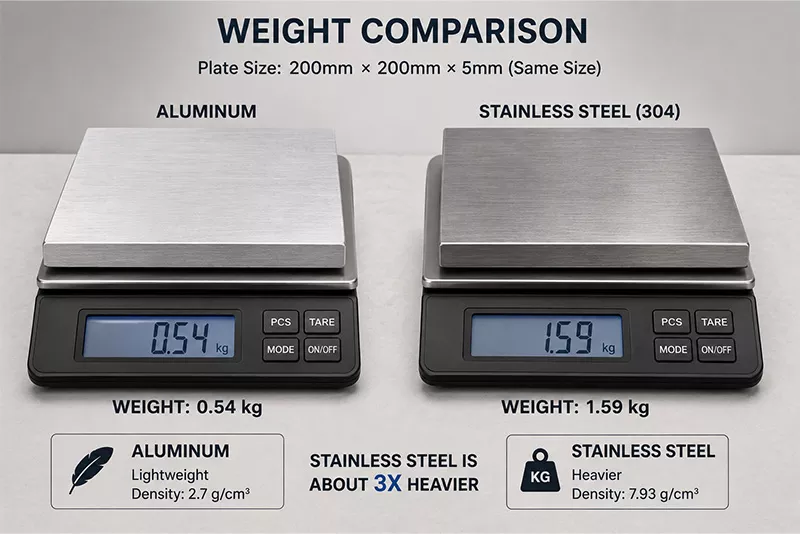
If two pieces have identical dimensions, stainless steel will feel much heavier.
Density Comparison
| Material | Density |
|---|---|
| Aluminum | 2.7 g/cm³ |
| Stainless Steel | 7.9–8.0 g/cm³ |
Stainless steel weighs nearly three times more than aluminum.
Many warehouse operators and fabrication shops use weight as the first inspection step before performing more advanced testing.
Method 2: Use a Magnet
Magnets provide useful clues, but they are not always definitive.
Aluminum
Always non-magnetic.
Stainless Steel
Depends on the grade.
Magnetic Grades
Usually Non-Magnetic Grades
Because 304 and 316 are usually non-magnetic, many people mistakenly assume they are aluminum.
This is one of the most common identification errors in fabrication shops.

Method 3: Observe Surface Appearance
Aluminum
Usually appears:
- Light gray
- Softer-looking
- Less reflective
- Slightly dull
Stainless Steel
Usually appears:
- Brighter
- More reflective
- More metallic
- Available in mirror finishes
Mirror-polished decorative products are usually stainless steel rather than aluminum.
Method 4: Look for Rust or Oxidation
Aluminum does not rust.
Instead, it forms a thin white oxide layer.
Stainless steel normally remains shiny, although poor-quality stainless steel or contaminated surfaces may show:
- Surface rust
- Tea staining
- Pitting corrosion
Reddish rust usually indicates steel rather than aluminum.
Method 5: Listen to the Sound
Tap the material gently with another metal object.
Aluminum
Produces:
- A dull sound
- Lower resonance
Stainless Steel
Produces:
- A sharper ringing sound
- Longer resonance
Experienced machinists can often distinguish them simply by sound.
Method 6: Perform a Spark Test
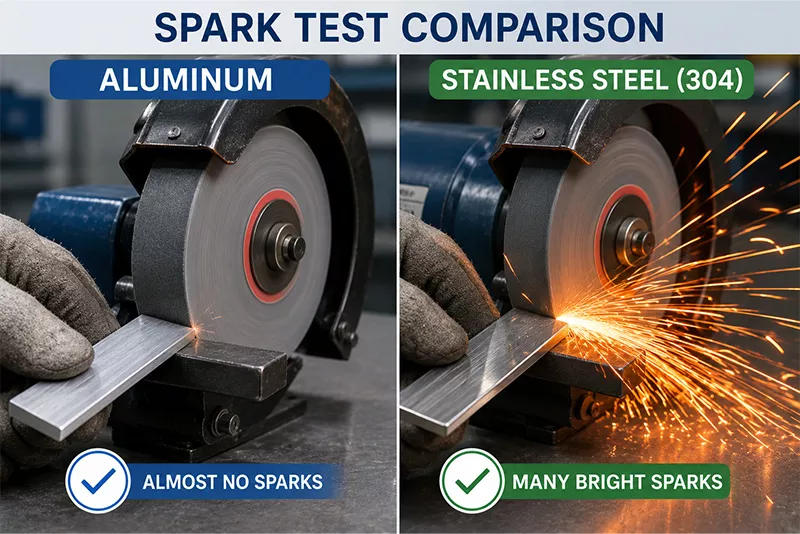
This method is common in machine shops and scrap yards.
Aluminum
Produces almost no sparks.
Stainless Steel
Produces visible orange sparks.
Scrap recyclers often use this method for rapid identification.
Since grinding slightly damages the surface, spark testing is generally unsuitable for finished products.
Method 7: Compare Heat Conductivity
Aluminum transfers heat much faster.
Cold aluminum often feels colder because it quickly draws heat away from your hand.
Stainless steel transfers heat more slowly.
This is why many cookware products use:
- Aluminum cores
- Stainless steel outer layers
to combine heat efficiency with corrosion resistance.
Method 8: Perform a Scratch Test
Aluminum is softer.
It scratches relatively easily.
Stainless steel is harder and more wear resistant.
Typical Hardness
| Material | Hardness |
|---|---|
| 6061 Aluminum | 95 HB |
| 304 Stainless Steel | 150–200 HB |
| 316 Stainless Steel | 150–220 HB |
This method should only be used on non-critical surfaces.
Method 9: Check Material Markings
Method 10: Use a PMI or XRF Analyzer
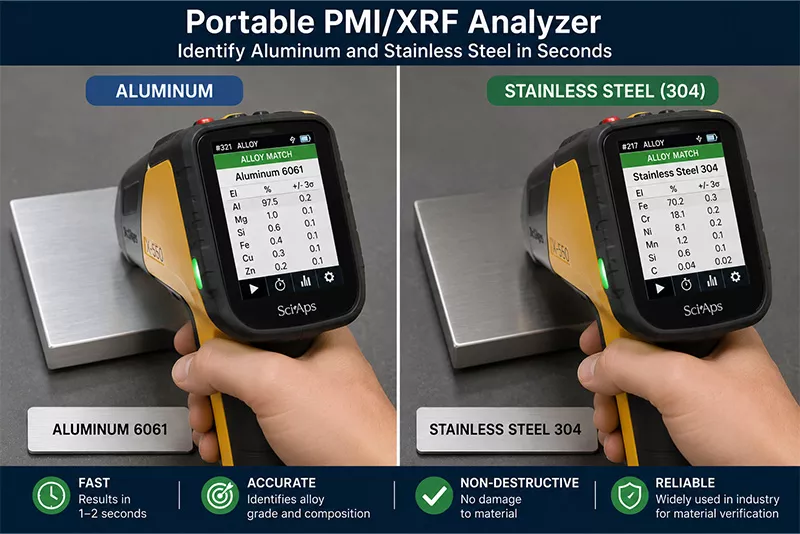
This is the most accurate method.
Portable analyzers identify chemical composition within seconds.
Aluminum Alloys
Contain elements such as:
- Al
- Mg
- Si
- Zn
Stainless Steel Grades
Contain:
- Fe
- Cr
- Ni
- Mo
PMI testing is widely used in:
- Pressure vessel manufacturing
- Oil and gas projects
- Food equipment fabrication
- Incoming material inspection
- Third-party quality control
For critical projects, experienced buyers combine PMI analysis with material certificates rather than relying on appearance.
Aluminum vs Stainless Steel Weight Comparison
Suppose you have two plates measuring:
1000 × 1000 × 3 mm
Aluminum
Approximately 8.1 kg
Stainless Steel
Approximately 24 kg
Even without instruments, the difference is easy to feel.
Aluminum vs Stainless Steel: Which Costs More?
Price depends on alloy, thickness, and market conditions.
Generally:
- Aluminum is lighter and often cheaper by weight.
- 304 stainless steel usually costs more than common aluminum alloys.
- 316 stainless steel is more expensive because of its nickel and molybdenum content.
However, choosing the cheaper material does not always reduce overall costs.
In many industrial applications, durability, strength, and maintenance costs matter more than the initial price.
Which Material Is Better?
It depends on your application.
Choose Aluminum When You Need
- Lightweight structures
- Good heat conductivity
- Easy machining
- Transportation applications
- Aerospace components
Typical applications:
- Aircraft parts
- Heat exchangers
- Automotive components
- Window frames
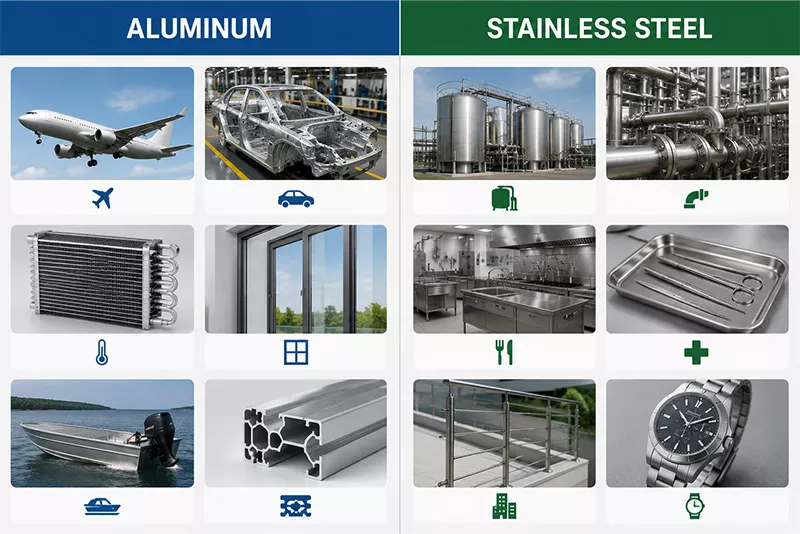
Choose Stainless Steel When You Need
- Higher strength
- Better wear resistance
- Food-grade performance
- High-temperature resistance
- Superior corrosion resistance
Typical applications:
- Tanks
- Pipes
- Pressure vessels
- Food processing equipment
- Chemical plants
Common Identification Mistakes
Assuming Non-Magnetic Means Aluminum
Not necessarily.
304 and 316 stainless steel are also usually non-magnetic.
Judging Only by Color
Both materials may appear nearly identical.
Ignoring Weight
Weight is often one of the fastest and most reliable field checks.
Trusting Labels Without Verification
Markings can be missing or incorrect.
For important projects, professional inspection is recommended.
What Should You Request From Your Supplier?
If material verification matters, ask for:
Material Test Certificate (MTC)
Confirms chemical composition and standards.
Heat Number Traceability
Ensures each batch can be traced.
PMI Inspection Report
Verifies the material matches the ordered grade.
Standard Information
Such as:
Reliable suppliers should provide these documents before shipment.
This helps reduce disputes and avoid material substitution problems.
Industrial Supply Considerations
For critical projects, material traceability matters as much as price.
Companies like Kongfang Metal supply stainless steel plates, coils, pipes, bars, and fabricated products with:
- Material Test Certificates
- Heat number traceability
- PMI verification
- ASTM, EN, JIS, and GB standards
These documents help ensure the correct material reaches your project.
Conclusion
So, how do you tell aluminum from stainless steel?
The most practical methods are:
- Weight comparison
- Magnet test
- Surface appearance
- Spark test
- Scratch test
- Material markings
- PMI analysis
Quick field tests are useful, but they are not foolproof.
For important industrial applications, combining material certificates with PMI verification remains the most reliable approach.
Understanding the difference between aluminum and stainless steel helps you avoid material mix-ups, choose the right welding process, and ensure long-term performance.
FAQs
Yes.
Brushed aluminum and brushed stainless steel can appear very similar, especially after surface finishing.
That is why experienced buyers rely on weight, markings, and PMI testing rather than appearance alone.
Stainless steel is approximately three times heavier than aluminum.
Weight comparison is often the quickest identification method.
Does aluminum stick to magnets?
Yes.
304 and 316 stainless steel are usually non-magnetic.
PMI or XRF analysis combined with material certificates provides the highest accuracy.
Yes.
Professional suppliers should provide:
- MTCs
- Heat numbers
- PMI reports
These documents help verify that the supplied material matches the ordered grade.


 EN
 ES
 RU
 FR
 PT
 DE
 JA
 KO
 ID
 TR
 AR
