
Inconel vs Stainless Steel
If you’re deciding between Inconel and stainless steel, the wrong choice can lead to premature failure at high temperatures, severe corrosion damage, or unnecessary material cost.
While both materials offer corrosion resistance, they are designed for completely different performance ranges.
Inconel is engineered for extreme environments, while stainless steel is optimized for cost-effective durability in general conditions.
This guide helps you determine when stainless steel is sufficient—and when only Inconel will work.

1. What Is Inconel?
Inconel is a family of nickel-based superalloys designed for high-temperature strength and extreme corrosion resistance.
Unlike stainless steel, Inconel maintains its mechanical properties under high heat, pressure, and aggressive chemical exposure.
Key Characteristics
- Excellent high-temperature strength
- Outstanding oxidation resistance
- Superior resistance to creep and fatigue
- Exceptional corrosion resistance in harsh environments
- Stable microstructure at elevated temperatures
Common Inconel Grades
| Grade | Key Feature | Typical Applications |
|---|---|---|
| Inconel 600 | General corrosion resistance | Chemical processing |
| Inconel 625 | Strong corrosion resistance | Offshore, marine |
| Inconel 718 | High strength + fatigue resistance | Aerospace, turbines |
Inconel is typically used where failure is not acceptable, especially in critical or safety-sensitive systems.
2. What Is Stainless Steel?
Stainless steel is an iron-based alloy containing chromium, which forms a protective oxide layer.
It is designed for corrosion resistance, strength, and cost efficiency.
Common Stainless Steel Grades
| Grade | Type | Typical Use |
|---|---|---|
| 304 | Austenitic | General industrial use |
| 316 | Austenitic | Marine / chemical |
| 2205 | Duplex | Structural + corrosion |
Companies like Kongfang Metal supply stainless steel in plates, pipes, coils, bars, and fabricated components for global industries.
3. Composition Comparison
| Element | Inconel | Stainless Steel |
|---|---|---|
| Base Metal | Nickel (50–70%+) | Iron |
| Chromium | Yes | Yes |
| Nickel | Very high | Moderate |
| Molybdenum | Often added | Sometimes |
| Iron | Low | High |
Key Difference
- Inconel = Nickel-based superalloy
- Stainless steel = Iron-based alloy
This difference determines performance in temperature and corrosion extremes.
4. High Temperature Performance (Critical Difference)
This is the most important comparison.
| Property | Inconel | Stainless Steel |
|---|---|---|
| Max Service Temp | ~700–1000°C+ | ~400–800°C |
| Strength at High Temp | Excellent | Drops significantly |
| Creep Resistance | Excellent | Limited |
| Oxidation Resistance | Outstanding | Moderate |
Engineering Insight
- Stainless steel loses strength rapidly above 600°C
- Inconel maintains structural integrity at extreme temperatures
If your system operates in high-temperature zones (turbines, furnaces, exhaust systems) → Inconel is often mandatory.

5. Strength and Mechanical Properties
| Property | Inconel 718 | Stainless Steel 304 |
|---|---|---|
| Tensile Strength | ~1000–1300 MPa | ~520–750 MPa |
| Yield Strength | ~700–1000 MPa | ~205 MPa |
| Fatigue Resistance | Excellent | Moderate |
Key Takeaways
- Inconel is much stronger, especially at high temperature
- Stainless steel is sufficient for most structural applications at normal temperatures
6. Corrosion Resistance
Both materials resist corrosion, but Inconel performs better in extreme environments.
Stainless Steel
- Good resistance in atmosphere and mild chemicals
- Sensitive to:
Inconel
- Excellent resistance to:
- seawater
- acids (sulfuric, phosphoric)
- chloride environments
- high-temperature oxidation
Inconel is preferred in offshore, chemical, and aerospace environments.

7. Oxidation & Scaling Resistance
At high temperatures:
- Stainless steel forms oxide scale that may spall or degrade
- Inconel forms a stable protective oxide layer
This makes Inconel ideal for:
- gas turbines
- heat exchangers
- high-temperature reactors

8. Fabrication and Machining
Stainless Steel
- Easy to weld and machine
- Widely available
- Lower processing cost
Inconel
- Difficult to machine (work hardening)
- Requires specialized tooling
- Higher fabrication cost
Suppliers like Kongfang Metal provide precision machining, cutting, and fabrication services for both materials.

9. Cost Comparison (Procurement Critical)
| Factor | Inconel | Stainless Steel |
|---|---|---|
| Material Cost | Very high | Moderate |
| Machining Cost | High | Low |
| Availability | Limited | Widely available |
| Lead Time | Longer | Shorter |
Procurement Insight
- Inconel can cost 3–10× more than stainless steel
- Use Inconel only when performance requires it
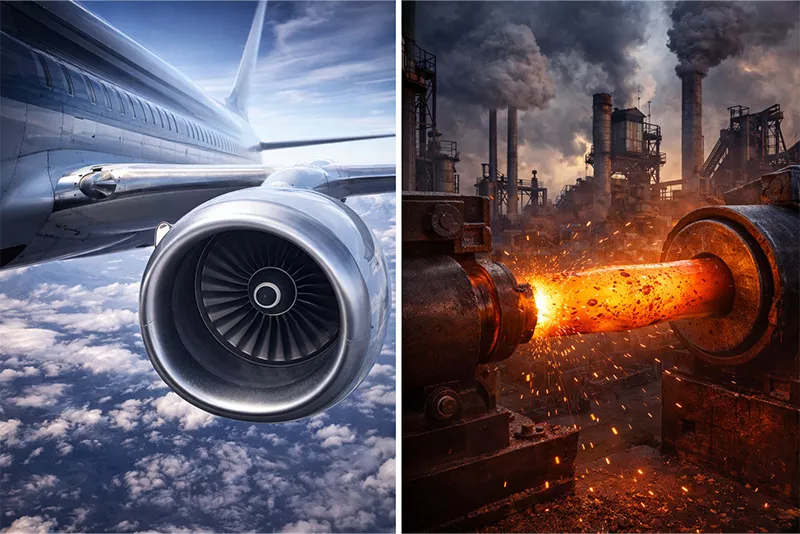
10. Application Comparison
Inconel Applications
Used where extreme performance is required:
- aerospace engines
- gas turbines
- nuclear systems
- offshore platforms
- chemical reactors
Stainless Steel Applications
Used where cost efficiency and durability matter:
- food processing equipment
- pipelines
- structural components
- storage tanks
11. When Should You Choose Each?
Choose Inconel When
- operating temperature exceeds ~600°C
- high creep resistance is required
- severe corrosion environment exists
- failure risk must be minimized
Choose Stainless Steel When
- temperature is moderate
- cost control is important
- general corrosion resistance is sufficient
- fabrication simplicity matters
FAQs
No. Inconel is superior in extreme environments, but stainless steel is more cost-effective for most applications.
Typically above 600–700°C, stainless steel begins to lose strength, and Inconel becomes the preferred option.
In most cases, no. Stainless steel cannot maintain strength or oxidation resistance at very high temperatures.
Because of:
- high nickel content
- complex alloy design
- difficult processing
- limited production volume
Yes. Inconel work-hardens quickly, requiring slower speeds and specialized tooling.
Inconel provides superior resistance to seawater and chloride corrosion, but stainless steel (316 / 2205) is often used for cost-effective solutions.
- Choose 316 for general marine applications
- Choose Inconel 625 for:
- higher temperature
- stronger corrosion conditions
- longer service life


 EN
 ES
 RU
 FR
 PT
 DE
 JA
 KO
 ID
 TR
 AR
