
Can You Weld Stainless Steel with a MIG Welder?
Yes — you can weld stainless steel with a MIG welder, and in many industrial applications, it’s actually one of the most efficient methods.
But here’s the key:
- MIG welding stainless steel is not the same as welding carbon steel
- If you use the wrong wire, gas, or settings, you will get poor corrosion resistance, spatter, and weak welds
This guide explains exactly how to do it right — from setup to real-world applications.
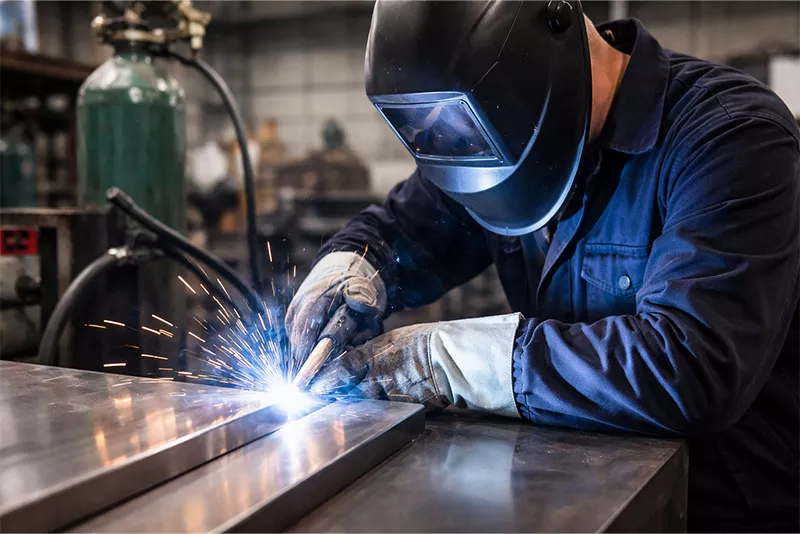
1. What Is MIG Welding for Stainless Steel?
MIG welding (GMAW) uses a continuous wire electrode + shielding gas to create the weld.
For stainless steel:
- The wire must match the base material
- Shielding gas must prevent oxidation
- Heat input must be controlled
Compared to TIG:
- Faster
- Easier to learn
- Better for production
Compared to Stick:
- Cleaner weld
- Higher efficiency
- Less post-cleaning
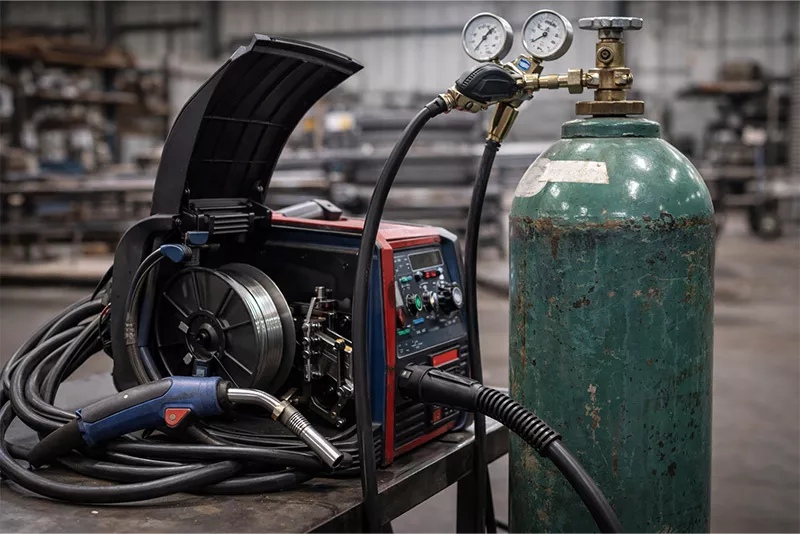
2. Can MIG Welding Produce High-Quality Stainless Steel Welds?
Yes — if done correctly, MIG welding can produce strong, clean welds.
But quality depends on 3 critical factors:
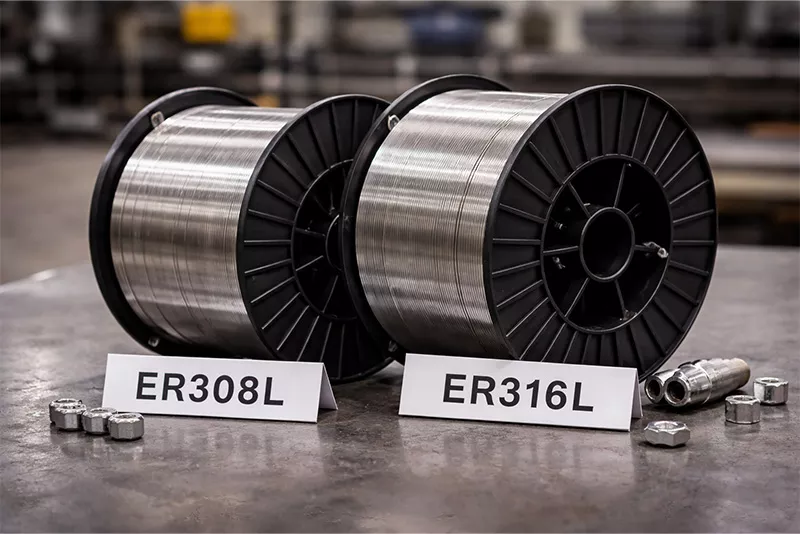
Correct Filler Wire Selection
Common MIG wires for stainless steel:
| Base Metal | Recommended Wire |
|---|---|
| 304 / 304L | ER308L |
| 316 / 316L | ER316L |
| 321 | ER347 |
| 430 | ER430 |
Rule: Always match or slightly over-alloy the filler
Proper Shielding Gas
This is where most people go wrong.
Recommended gas mixes:
- 98% Argon + 2% CO₂ → most common
- Tri-mix (Ar + He + CO₂) → better for thicker sections
- Argon + 1–2% O₂ → smoother arc
Avoid:
- Pure CO₂ → causes oxidation & poor corrosion resistance
Heat Control (Critical)
Stainless steel is sensitive to heat.
Too much heat causes:
- Burn-through
- Warping
- Loss of corrosion resistance
Best practice:
- Short arc transfer (for thin material)
- Pulse MIG (for higher quality)
3. MIG vs TIG for Stainless Steel
| Factor | MIG | TIG |
|---|---|---|
| Speed | Fast | Slow |
| Skill level | Easier | Requires experience |
| Weld appearance | Good | Excellent |
| Heat control | Moderate | Precise |
| Best use | Production | High-end / thin material |
Conclusion:
- Use MIG → production, structures, medium thickness
- Use TIG → precision, food-grade, thin materials
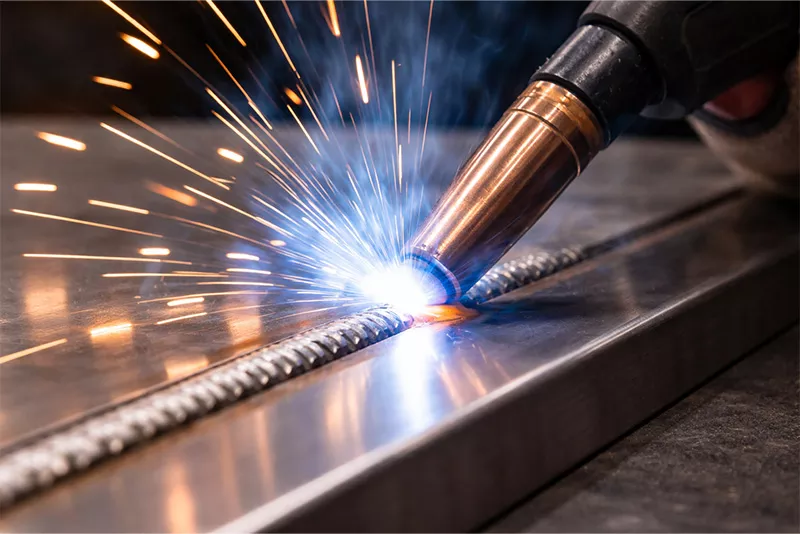
4. Typical Applications of MIG Welding Stainless Steel
MIG welding is widely used in:
Industrial Fabrication
- Structural frames
- Equipment housings
- Support structures
Tanks & Containers
- Storage tanks
- Chemical vessels
- Water systems
Pipeline Systems
- General piping (non-critical welds)
- HVAC systems
Mass Production
- Automotive parts
- Metal fabrication shops
- OEM components
5. Common Problems When MIG Welding Stainless Steel
Excessive Spatter
Cause:
- Wrong gas
- Incorrect voltage
Solution:
- Use proper gas mix
- Adjust parameters
Poor Corrosion Resistance
Cause:
- Contamination
- Overheating
Solution:
- Clean material before welding
- Use correct filler
Burn-Through
Cause:
- Too much heat
Solution:
- Lower amperage
- Increase travel speed
Discoloration (Heat Tint)
Cause:
- Oxidation
Solution:
- Improve shielding gas coverage
- Post-weld cleaning
6. How to MIG Weld Stainless Steel (Step-by-Step)
Step 1: Clean the Surface
- Remove oil, rust, dirt
- Use stainless-only brushes
Step 2: Set Up Equipment
- Install correct wire
- Select gas mix
- Adjust voltage & feed speed
Step 3: Welding Technique
- Maintain short arc
- Keep steady travel speed
- Avoid excessive weaving
Step 4: Post-Weld Cleaning
- Remove discoloration
- Pickling or passivation if required

7. When Should You Use MIG Welding for Stainless Steel?
Choose MIG when:
- You need high productivity
- Material thickness is medium or thick
- Appearance is not the top priority
- Cost efficiency matters
Avoid MIG when:
- Ultra-thin materials
- Food-grade / sanitary welds
- High-precision requirements
8. Is MIG Welding Stainless Steel Cost-Effective?
Yes — in most industrial cases.
Reasons:
- Faster welding speed
- Lower labor cost
- Suitable for automation
That’s why many factories prefer MIG for:
- Structural stainless steel
- Mass production components
9. Key Buying Considerations (Very Important)
Before welding stainless steel, confirm:
- Material grade (304 / 316 / duplex, etc.)
- Welding wire compatibility
- Shielding gas availability
- Thickness and joint design
- Corrosion resistance requirements
Correct planning = better weld quality + lower cost
10. Processing Options Available from Kongfang Metal
To support your fabrication projects, Kongfang Metal provides:
- Precision cutting
- CNC machining
- Laser cutting
- Bending & forming
- Welding fabrication
- Surface finishing
You receive ready-to-install components, not just raw materials.
FAQs
Yes, MIG is easier than TIG and suitable for beginners.
Yes — typically argon-based mixtures. Pure CO₂ is not recommended.
Yes, when done correctly, it produces strong welds suitable for industrial use.
If done incorrectly (wrong gas or contamination), corrosion resistance can be reduced.
ER308L and ER316L are the most common.


 EN
 ES
 RU
 FR
 PT
 DE
 JA
 KO
 ID
 TR
 AR
