
Temperature Converter (°C / °F / K)
When working with heat-resistant stainless steels, temperature units matter.
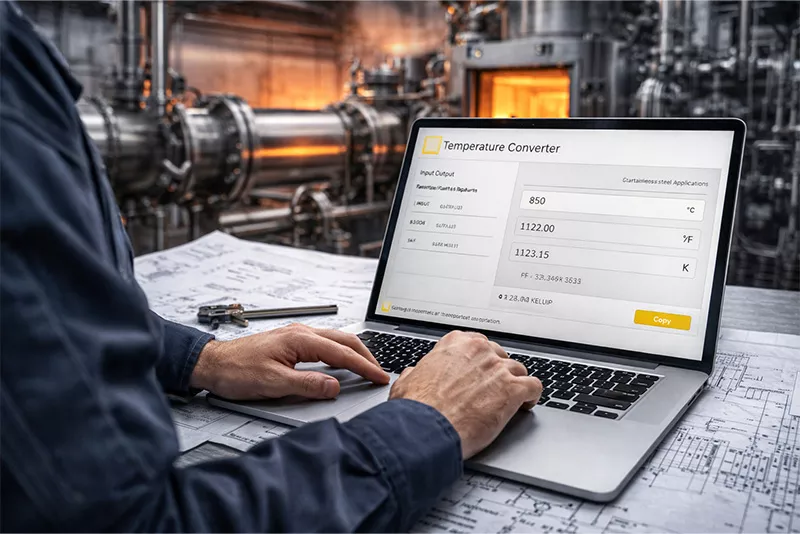
This calculator converts °C, °F, and K instantly, helping you avoid mistakes in material selection, specifications, and international communication.
Temperature Conversion Calculator
Notes
For material selection at high temperature, always confirm design code requirements and allowable stress at temperature.
© Kongfang Metal — Tools
You input
A temperature value
Select °C, °F, or K
You get
The equivalent temperature in the other two units
This tool is designed for engineering and industrial use, especially in high-temperature stainless steel applications.
Why Temperature Conversion Matters in Steel Projects
In real projects, temperature values often come from different sources:
European drawings use °C
US specifications often use °F
Material data sheets and standards use K
Incorrect conversion can lead to:
wrong material grade selection
unsafe allowable stress assumptions
misunderstanding between supplier and buyer
This is especially critical for heat-resistant steels.

Typical Applications
This calculator is commonly used in:
Furnaces and heat exchangers
Pressure vessels and piping
Thermal process design
International engineering documents
If you frequently switch between design codes and material datasheets, this tool saves time and reduces risk.
Common Temperature Conversion Rules
For reference, the calculator follows standard formulas:
K = °C + 273.15
°C = K − 273.15
°F = °C × 9/5 + 32
°C = (°F − 32) × 5/9
These formulas are exact and consistent with international standards.
Example Conversions (Quick Check)
| °C | °F | K |
|---|---|---|
| 400 | 752 | 673.15 |
| 600 | 1112 | 873.15 |
| 800 | 1472 | 1073.15 |
| 900 | 1652 | 1173.15 |
| 1000 | 1832 | 1273.15 |
These ranges are commonly seen in 310S and 253MA service conditions.

High-Temperature Stainless Steel Note
Temperature is not just a number.
For heat-resistant materials, it directly affects:
allowable stress
oxidation resistance
service life
As one of China’s most experienced stainless steel manufacturers serving global markets, Kongfang Metal supplies high-temperature stainless steel grades including 310S, 309S, and 253MA in plate, pipe, and coil form.
When confirming material suitability, it is essential to match temperature units and actual service conditions correctly.
Common Mistakes to Avoid
1. Mixing °C and °F in specifications
Always confirm which unit the drawing or standard uses.
2. Forgetting Kelvin in material data
Many creep and oxidation charts are based on K, not °C.
3. Rounding too early
Convert first, then round at the final step when preparing documents.
FAQs
Kelvin is commonly used in material science, thermodynamics, and creep data, especially in standards and research data.
Most international steel standards use °C, while some US documents use °F.
Yes, for unit conversion only. Always follow your design code for allowable stress and temperature limits.
Yes. As temperature increases, allowable stress generally decreases, especially for austenitic steels.


 EN
 ES
 RU
 FR
 PT
 DE
 JA
 KO
 ID
 TR
 AR
